
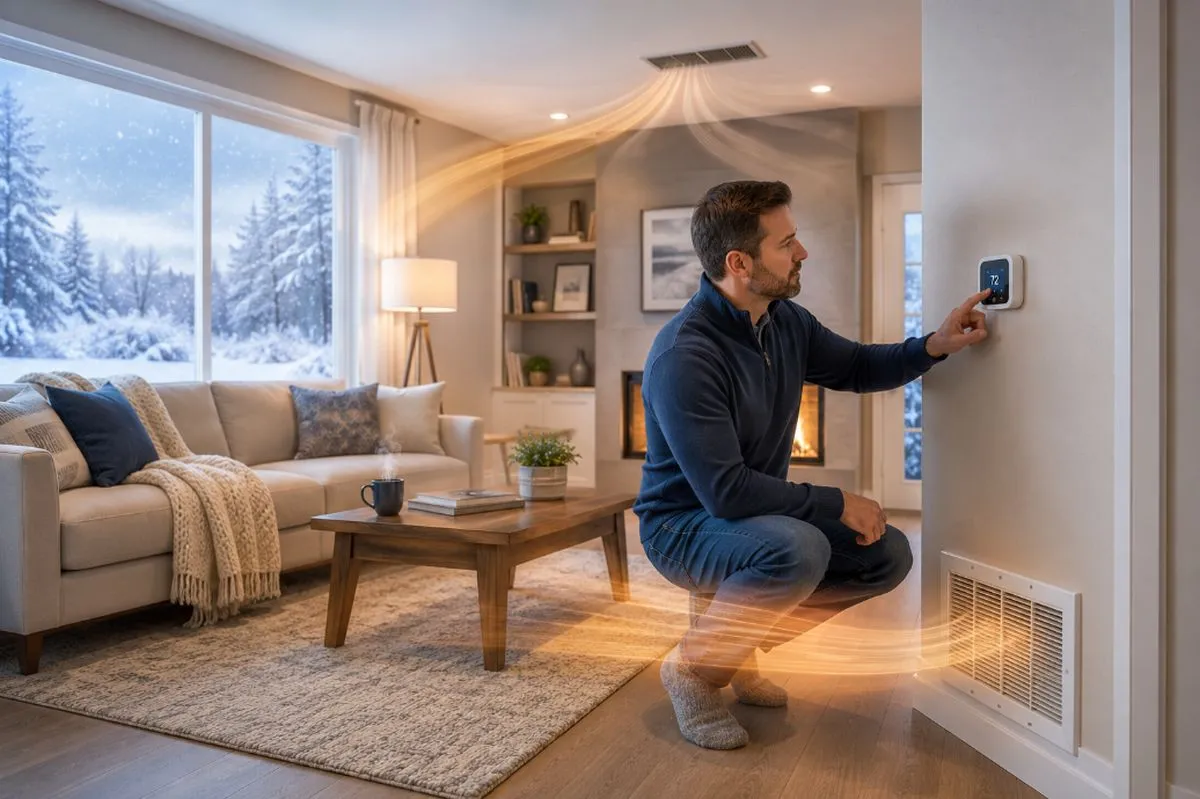
A cold snap does not care what your thermostat is set to. When temperatures in the San Joaquin Valley drop into the 20s and 30s overnight, your heating system has to move more air, more often, to keep the house at temperature. Most national cold weather guides are written for climates where heating carries the whole winter. San Joaquin Valley systems are not built that way. They are sized and maintained around a long cooling season, so the heating side is often the part nobody has stress tested until a hard freeze forces the issue. At HVACSync.com, we have seen that most winter comfort complaints during a hard freeze trace back to one issue: restricted airflow, not a broken system. A dirty filter, a blocked vent, or leaky ductwork forces your furnace or heat pump to work harder while delivering less warm air to the rooms that need it. This guide walks through the airflow checks our technicians run first during a cold snap, in the order that solves the most problems the fastest.
TL;DR Quick Answers
Most cold snap airflow problems trace back to a dirty filter, a closed or blocked vent, or leaky ductwork. Check your filter first: hold it to a light, and if you cannot see through it, replace it before doing anything else. Keep every supply and return vent open, since closed vents raise duct pressure instead of saving energy. Seal visible duct leaks in the attic or crawlspace, since unconditioned ducts can lose 20 to 30 percent of your heated air. Hold your thermostat at one steady setting rather than pushing it up and down, since large swings force costly backup heat.
Top Takeaways
- A clogged filter is the single most common cause of restricted airflow during a cold snap. Our technicians check it first on every winter service call.
- Closing vents in unused rooms does not save energy. It raises static pressure in your ducts and can trip the same safety shutoff a dirty filter causes.
- San Joaquin Valley ductwork often runs through attics and crawlspaces that were never designed to hold heat, so sealed, insulated ducts matter more here than in a mild climate.
- Heat pumps lose efficiency as outdoor temperatures fall, and pushing the thermostat higher during a freeze often triggers expensive backup electric heat instead of faster warmth.
- Tule fog and stagnant winter air trap dust and smoke particles close to the ground in the Valley, which loads a return-air filter faster than the standard 90 day schedule allows.
- Dry winter air feels colder than humid air at the same temperature. Keeping indoor humidity between 30 and 40 percent can make 68 degrees feel as warm as 70 or 71 without touching the thermostat.
- A carbon monoxide alarm and an annual combustion safety check are not optional during extended cold weather. If yours sounds, shut the system down and call a licensed technician.
What a Cold Snap Does to Your HVAC Airflow
A hard freeze changes how your heating system behaves, not just how hard it runs. The National Weather Service issues a freeze warning for the Valley whenever widespread sub-freezing temperatures are expected, and that threshold is a reasonable trigger for the airflow checks in this guide. Once outdoor temperatures drop into the 20s and low 30s across the San Joaquin Valley, your furnace or heat pump runs longer cycles to keep pace with heat loss through walls, windows, and ductwork. Valley winters also bring stagnant, foggy air from the temperature inversions the San Joaquin Valley Air Pollution Control District documents for this region, and that stagnant air holds dust and smoke particles close to the ground, right where your return vents pull air from. At HVACSync.com, we have found that systems already running near their airflow limit in October cross into restricted airflow territory once a cold snap hits, because there is no longer any slack in the system. The result is a house that never quite reaches the set temperature, along with a system that short cycles as safety switches respond to the added strain. Airflow problems that were minor in mild weather become the difference between a comfortable home and a service call once a freeze sets in.
Signs Your Airflow Is Restricted
Check for these five signs before you start troubleshooting, since they tell you whether airflow is really the problem. One or two rooms stay noticeably colder than the rest of the house no matter how long the system runs. The system runs in long, continuous cycles instead of the shorter cycles you would see in mild weather. You hear a faint whistling or hissing sound near the filter slot or a return grille, which usually means air is being forced through a gap that is too small. Air coming out of the supply vents feels weaker than usual, even standing close to the vent. Your energy bill jumps by more than the colder weather alone would explain. Our technicians run through this exact list in the first five minutes of every winter service call, before touching a single tool, because it points to the fix faster than guessing at the equipment ever does.
Check and Change Your Filter First
The fastest fix for restricted airflow during a cold snap is also the cheapest. A clogged filter chokes the return air your furnace needs to run safely, and the heat exchanger can overheat well before your home reaches temperature. The same restriction that weakens cooling performance and drives up bills in summer works against your furnace or heat pump in winter, just from the opposite direction. Pull the filter and hold it up to a bright light. If light does not pass through it, replace it before checking anything else. Our technicians in the field recommend MERV 8 to MERV 11 for most Valley homes, since that range captures dust and agricultural particulate without choking airflow. During a cold snap, check the filter every 30 days instead of the standard 60 to 90, since a system running near continuously loads a filter far faster. Where you buy the replacement filter matters less than getting the size and rating right every time. A subscription service like Filterbuy ships the correct size on a schedule, which removes the guesswork during a season when checking the filter monthly is already one more thing on the list.
Open Every Supply and Return Vent
Walk the house room by room and check every vent, not just the ones in rooms you use daily. Furniture, rugs, and holiday decorations shift throughout the season and often end up blocking a supply register or return grille without anyone noticing. Our technicians in the field find at least one blocked vent on the majority of winter airflow calls, and it is almost never the room the homeowner would have guessed. Closing vents in unused rooms is a persistent myth. It does not reduce energy use. It raises static pressure inside your ductwork, forces the blower to work harder, and can trigger the same safety shutoff that a dirty filter causes. If you want to direct more heat toward occupied rooms, close the interior doors instead and leave every vent open.
Duct Airflow in Cold Weather: Where Valley Homes Lose Heat
Ductwork that runs through an attic, crawlspace, or garage loses heat every time your system runs, and that loss gets worse as the temperature gap between conditioned and unconditioned space widens during a freeze. Leaky, unsealed ducts in unconditioned spaces can lose 20 to 30 percent of the heated air your system produces, according to ENERGY STAR. In homes we have serviced across Fresno and Tulare counties, that loss shows up as rooms that never reach the thermostat setting no matter how long the system runs. Sealing accessible joints with mastic or UL-181 rated foil tape, not cloth duct tape, recovers a meaningful share of that lost heat and reduces the runtime needed to hit your target temperature.
Heat Pump Airflow and Efficiency Below Freezing
Heat pumps move heat rather than generate it, which means their capacity naturally declines as outdoor temperatures drop. What surprises most homeowners is that airflow restriction hurts a heat pump more than it hurts a furnace, since a heat pump is already working with a thinner efficiency margin once the temperature drops. Standard heat pumps typically need supplemental electric heat once temperatures fall into the 25 to 35 degree range, while cold climate models hold more of their capacity into the low 20s and below, based on Department of Energy testing. In our experience, the instinct to push the thermostat higher during a freeze usually backfires on a heat pump system, since it can trigger backup electric resistance heat that costs several times more per hour than normal operation. A steady setpoint, combined with clear airflow at every vent and return, keeps a heat pump working in its efficient range longer during a cold snap.
Preventing Airflow Blockage Outside the Home
Airflow problems are not limited to what happens inside the ductwork. Furnace exhaust and intake pipes can get buried by debris, blocked by nesting material, or iced over during a hard freeze, and a blocked exhaust triggers the same safety lockout as a dirty filter or a closed vent. In our experience, a buried flue cap is the last place homeowners think to check, since the instinct during a freeze is to look at the thermostat and the filter before anyone walks outside. After any significant cold snap, walk the exterior of the house and clear a two foot radius around the flue cap or PVC exhaust pipe. If you notice soot near a vent, smell burning, or your carbon monoxide alarm activates, stop troubleshooting immediately, shut the system down, and call a licensed HVAC technician. Combustion safety issues are never a do it yourself repair.
Thermostat and Fan Settings That Protect Airflow
Two thermostat habits do more to protect airflow during a cold snap than any single repair. First, hold one steady temperature instead of swinging it up and down, since large setbacks force the system to work harder to recover and can trigger backup heat on a heat pump. Second, consider switching the fan setting from Auto to On or Circulate during extreme cold, which keeps air moving between heating cycles and evens out temperature swings between rooms. Our technicians in the field see fewer cold spot complaints in homes that run this setting through a hard freeze, though it does use slightly more electricity while it is active.
Managing Indoor Humidity During a Cold Snap
Cold outdoor air holds very little moisture, and once your furnace or heat pump heats it, indoor relative humidity can fall into the teens even when airflow is working perfectly. Dry air feels colder at the same thermostat setting, which pushes many homeowners to raise the temperature instead of fixing the real problem, adding more strain to a system that is already working hard during a freeze. Aim for 30 to 40 percent relative humidity indoors, measured with a basic hygrometer from a hardware store. In our experience, homes that hold humidity in that range at 68 degrees feel as comfortable as homes running two or three degrees warmer with dry air, which is a cheaper fix than turning up the heat. Do not overshoot: humidity above 50 percent during a cold snap causes condensation on cold windows and door frames, which can lead to mold in the same weeks your ductwork is already working overtime.
Your 2-Minute Cold Snap Airflow Checklist
This is the same order our technicians work through on every winter service call, condensed for five minutes at home before you decide whether to call anyone.
- Pull the filter and hold it to a light. Replace it if you cannot see through it.
- Walk every room and open each supply and return vent.
- Check indoor humidity with a hygrometer and aim for 30 to 40 percent.
- Set the thermostat to one steady temperature and leave it there.
- Switch the fan to On or Circulate during the worst of the freeze.
- Walk the exterior and clear the flue cap or PVC exhaust of snow, ice, or debris.
When Reduced Airflow Signals a Bigger Problem
Most airflow issues during a cold snap resolve with a filter change, open vents, and a clear exterior exhaust. Some do not. If your system short cycles after you have addressed the filter and vents, if one or two rooms never warm up despite an otherwise functioning system, or if a heat pump ices over and does not clear during its defrost cycle, the cause is likely a duct leak, a refrigerant issue, or a failing blower motor that needs a licensed technician. If the diagnosis points to a major component failure rather than a simple airflow fix, our heat pump repair versus replacement guide walks through the cost thresholds that make one option clearly the better financial call. At HVACSync.com, we recommend a professional airflow assessment before the coldest part of the season if your system struggled to keep up last winter, rather than waiting for a hard freeze to expose the same problem again.
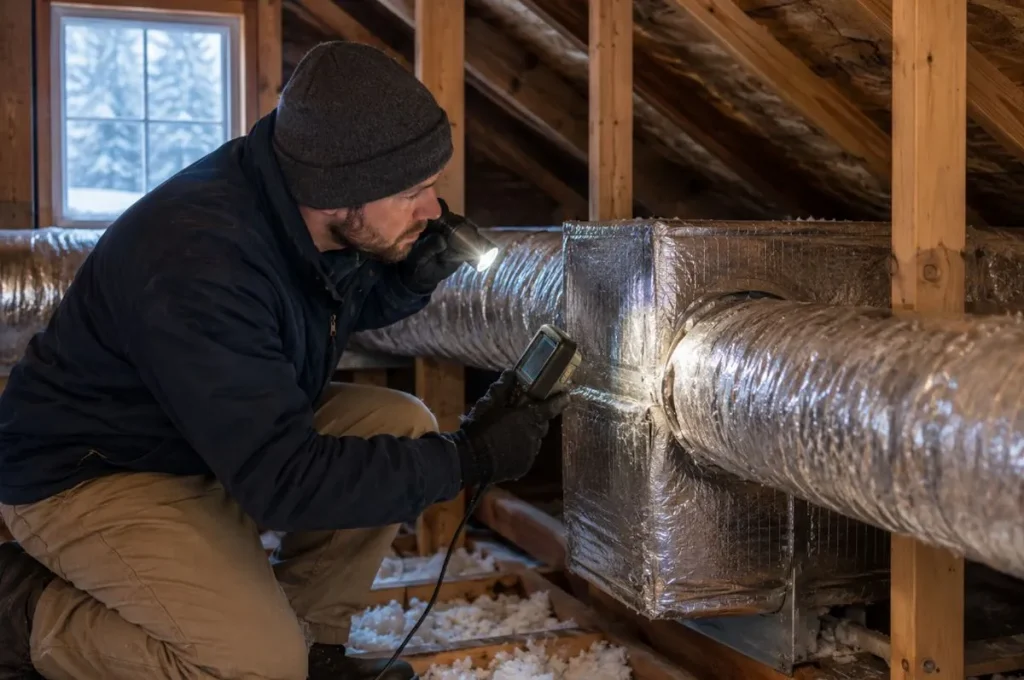
“Most of our cold snap calls sound the same. The furnace has been running nonstop, the house still feels ten degrees off, and the homeowner is bracing for bad news about the equipment. Nine times out of ten, we find a filter nobody has changed since October or a vent someone closed going into the holidays. We check airflow before we check anything electrical or mechanical, because in this climate, restricted air is the first thing that fails and the cheapest thing to fix.”
Essential Resources: Trusted Sources for Cold Snap Airflow Decisions
These seven sources go further than this guide on filters, ductwork, safety, and regional air conditions. Each one answers a specific next question a San Joaquin Valley homeowner would have after reading the tips above.
Get Deeper Filter Guidance for This Exact Topic
Filterbuy companion piece, Cold Snap Airflow Tips, goes deeper on filter sizing, replacement schedules, and fan settings than this guide covers, making it the natural next stop for filter-specific decisions.
Stop Losing Heated Air Through Unsealed Ducts
The U.S. Department of Energy explains how duct insulation, air sealing, and combustion safety checks fit into a whole-house weatherization plan, the same fixes this guide points to when ductwork is the source of restricted airflow.
Get Your Home’s Winter Ventilation Rate Right
The U.S. Environmental Protection Agency breaks down how much fresh air a sealed up winter home actually needs, useful context once filter and duct airflow are already addressed.
Protect Your Family From Carbon Monoxide Risk
The U.S. Consumer Product Safety Commission covers correct CO alarm placement and annual heating system inspections, essential reading before troubleshooting a blocked exhaust yourself.
Know Exactly When a Freeze Warning Applies to You
The National Weather Service defines the difference between a freeze watch, a freeze warning, and a frost advisory, so you know when Valley conditions cross the threshold that triggers the checks in this guide.
Prepare Your Whole Home for Extended Cold
Ready.gov, the Federal Emergency Management Agency’s preparedness site, covers insulation, weather stripping, and emergency planning for extended cold weather beyond airflow alone.
Understand Why Valley Winters Trap Dust Indoors
The San Joaquin Valley Air Pollution Control District documents the temperature inversions that leave San Joaquin Valley winters stagnant and dust heavy, the regional condition behind the faster filter loading this guide recommends.
Supporting Statistics
- 20 to 30 Percent of Heated Air Is Lost to Leaky Ducts
- Leaky, unsealed ductwork in unconditioned spaces loses 20 to 30 percent of the air moving through it.
- Source: ENERGY STAR, Duct Sealing
- Field note: in the homes our technicians service, that loss shows up as rooms that never reach the thermostat setting during a cold snap.
- 36 Percent of Winter CO Deaths Happen in December, January, or February
- Deaths from unintentional carbon monoxide poisoning peak in the winter months.
- Source: Centers for Disease Control and Prevention, National Vital Statistics System
- Field note: this is why we treat exterior exhaust checks as a required step after every hard freeze, not an optional one.
- 46 Percent of Home Energy Use Goes to Space Heating
- Space heating accounts for 46 percent of total energy consumption in the average U.S. single-family detached home.
- Source: U.S. Energy Information Administration, Residential Energy Consumption Survey
- Field note: airflow restrictions during a cold snap push that share even higher, since a restricted system runs longer to deliver the same warmth.
Final Thoughts
A cold snap does not create new problems in your HVAC system. It exposes the ones that were already there. The filter that should have been changed in November, the vent that got buried under a moving box, and the duct joint that has been leaking since summer all become obvious the moment your system has to work at full capacity. At HVACSync.com, we have seen that homeowners who check filter, vents, and exterior exhaust at the first sign of a freeze avoid the majority of cold weather service calls entirely. The ones who wait usually end up calling during the coldest week of the year, when a technician’s schedule is hardest to get onto. The systems we see fail hardest every winter are rarely the oldest ones. They are the ones nobody walked around and checked back in October. Handle the airflow basics before the next hard freeze reaches the Valley, not during it.
FAQ
Why does my furnace run constantly during a cold snap?
Longer, more frequent cycles are normal once outdoor temperatures drop sharply, since your system has to replace heat lost through walls, windows, and ductwork faster than it does in mild weather. Frequent short cycling, where the system starts and stops every few minutes, usually points to restricted airflow instead. Check the filter and vents first.
Should I change my filter more often during a cold snap?
Yes. A system running near continuously loads a filter much faster than the standard 60 to 90 day schedule assumes. Check it every 30 days during extended cold weather, and replace it as soon as light stops passing through it when held up to a bulb.
Does the filter brand matter, or just the MERV rating?
The MERV rating and a correct fit matter far more than the brand on the box. Any filter rated MERV 8 to 11 that seals tightly in the frame will perform about the same. If remembering to reorder is the real obstacle, a subscription option like Filterbuy takes that step off your plate by shipping the right size automatically.
Is it bad to close vents in rooms I do not use?
Closing vents does not lower your energy use. It raises pressure inside your ductwork, forces the blower to work harder, and can trigger the same safety shutoff a dirty filter causes. Keep vents open and close interior doors instead if you want to direct more heat to occupied rooms.
Can a heat pump keep up during a San Joaquin Valley cold snap?
Standard heat pumps typically need backup electric heat once temperatures fall into the 25 to 35 degree range, while cold climate models hold more capacity into the low 20s. Most Valley cold snaps stay within a range standard equipment can handle, but a system that already struggled last winter is worth having assessed before the next one.
What humidity level should I keep my home at during a cold snap?
Aim for 30 to 40 percent relative humidity, checked with a basic hygrometer. Cold outdoor air holds very little moisture, so indoor humidity can drop into the teens once your system heats it, which makes the same thermostat setting feel colder than it should. Staying in the 30 to 40 percent range lets you feel comfortable at a lower, cheaper setpoint.
When should I call a technician instead of troubleshooting airflow myself?
Call a licensed technician if your system will not start, if you smell burning or see soot near a vent, if a carbon monoxide alarm sounds, or if short cycling continues after you have checked the filter and every vent. Any suspected carbon monoxide issue is never a do it yourself repair.
Get a Field-Calibrated Airflow Check Before the Next Freeze
Not sure whether your airflow problem is a quick fix or something bigger? Get a free, field-calibrated HVAC assessment from a San Joaquin Valley technician who checks filter, vents, and ductwork before recommending anything. Schedule your cold snap airflow check with HVACSync.com today.